
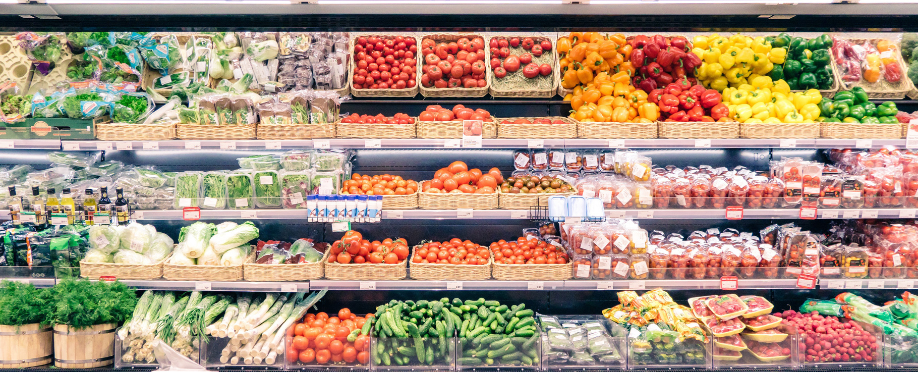
From keeping up with the latest consumer expectations to managing net zero legislation standards, grocery retailers have enough challenges — without letting shrink further erode their bottom line. This makes shrink reduction increasingly critical for facilities managers in the grocery space.
Keep reading to learn how to reduce shrink in a grocery store as well as other food retail settings with some of the industry’s most cutting-edge shrink reduction strategies in use today.
What Does “Shrink” Mean in Retail?
Grocery shrink, which essentially means inventory loss, is one of the oldest challenges in retail. Shrink can stem from a variety of causes — including theft, damage, expiry, administrative error, and equipment issues. While shrink impacts all types of retailers, grocery stores are at a much greater risk due to the high volume of perishable goods they sell.
What Is Shrink Reduction?
Shrink reduction is the act of preventing the loss of product from a retail setting.
As George Campbell, head of technical services at City US, can attest, the ROI makes it well worth investing in shrink reduction strategies: “When you consider that grocery stores lose as much as over three percent of total sales each year to shrink,” he says, “Even if you can reduce that by as little as 10%, the savings can be enormous.”
Shrink reduction resources include the various tools and strategies that minimize product loss, including:
- Inventory management systems
- Employee training programs
- Security cameras and surveillance
- Access control measures
- Regular audits and cycle counts
- Anti-theft technology, e.g., RFID tags, electronic article surveillance (EAS), and barcode scanning
- Preventive and predictive maintenance
- Refrigeration management best practices
In this article, we’ll be focusing in particular on shrink reduction resources that reduce food loss.
How Shrink Harms Retailers
According to one recent report, 60 percent of grocers agree that fresh products are important to their business. However, two-thirds of grocers are missing out on more than 1.5 percent of annual revenue due to expired or spoiled products. A McKinsey study found that shrink levels are particularly high in the ready-to-eat and ready-to-heat categories, where it can impact as much as 15 percent of revenues.
In addition to denting product margins, shrink can also lead to reputational harm. Grocers are also at risk from “unmeasurable” shrink, which occurs when customers have bad experiences like buying sour milk or lettuce that goes bad in two days instead of a week. When this happens repeatedly, customers are likely to switch grocers altogether — and maybe even complain about the store on social media.
How To Reduce Shrink in a Grocery Store: 4 Shrink Reduction Strategies
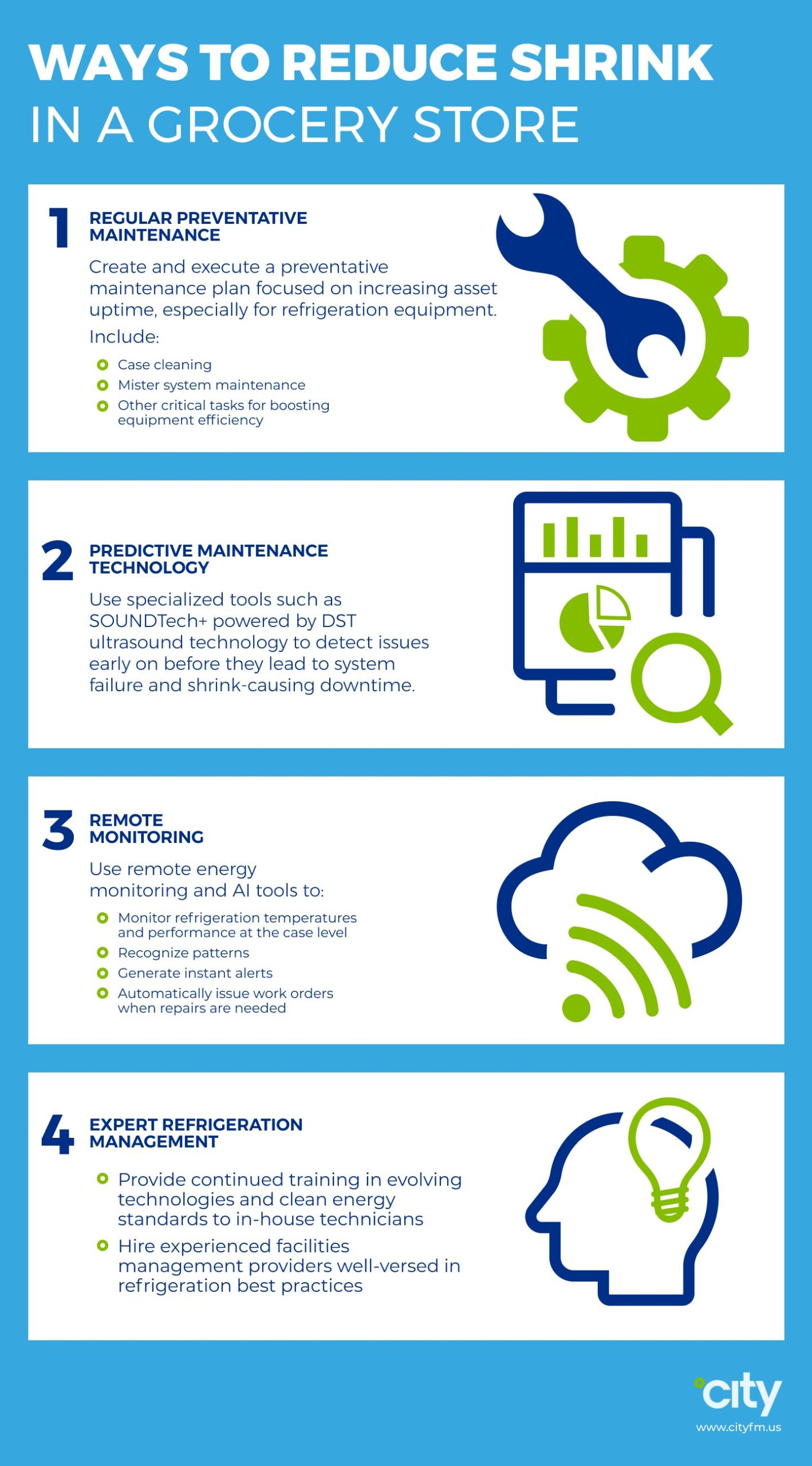
There are several facilities-related causes behind shrink in grocery stores — from power outages and unexpected equipment downtime to refrigeration issues and insufficient maintenance — among other reasons. Luckily it can be managed with some basic best practices. The best way to reduce shrink in a grocery store or other food retail facility is to apply the following strategies as part of your facilities management program:
1. Regular preventative maintenance
The prevention of grocery shrink largely hinges on the condition of refrigeration and other equipment. This makes creating and executing a preventative maintenance program focused on increasing asset uptime an important foundation for any shrink reduction program.
Start with a priority-driven plan with preventive maintenance checklists that stresses regular case cleaning, mister system maintenance, and other critical maintenance tasks for boosting the efficiency of equipment that keeps products fresh. In particular, facilities managers increasingly recognize the importance of regular case cleaning, which involves:
- Cleaning condenser coils and evaporators
- Ensuring proper drainage at the bottom of cases
- Preventing water leaks
- Vacuuming and cleaning out old product
2. Ultrasound predictive maintenance technology
Just like preventative maintenance plans, predictive maintenance is all about avoiding issues before they begin — but in this case, specialized tools are used to monitor the performance of equipment to detect issues early on before they lead to system failure (and shrink-causing downtime).
Various predictive maintenance abound, including ultrasound technology, infrared analysis, vibration analysis, laser-shaft alignment, oil analysis, and the use of AI and machine learning in predictive analytics.
At City, Campbell has spearheaded the use of SOUNDTech+ ultrasound technology, the City branded predictive maintenance tool powered by DST, for refrigeration equipment. A seasoned hands-on technician himself, he was astonished at the results of City’s 10-month pilot program, in which SOUNDTech+ prevented catastrophic refrigeration failure before the issue became a problem — with 98% accuracy.
Campbell predicts that ultrasound predictive maintenance technology, used in tandem with a preventative maintenance schedule, will become a major asset for grocery retailers seeking to prevent product loss.
3. Remote monitoring
With remote energy monitoring, equipment sensors are connected to computerized maintenance management systems (CMMS) and energy management systems (EMS) or energy management software. By generating instant alerts, spotting patterns, and automatically issuing work orders when repairs are needed, this has become a vital strategy for remotely monitoring and controlling energy consumption of units such as refrigeration, hot bars, and other food and beverage equipment.
For example, City has developed a robust analytics platform that sits on top of EMS systems and targets anomalies in asset specification or energy consumption at partner sites. If temperatures spike or fall outside their expected range, the program sends alerts to facilities managers who can investigate and address issues before food spoils, avoiding costly grocery shrink and equipment repairs. In some cases, problems can even be fixed remotely.
Additionally, AI tools can be used to monitor refrigeration temperatures and performance at the case level, preventing grocery shrink and assigning preventative maintenance tasks to field resources.
4. Expert refrigeration management
Thanks to rapidly evolving technologies and increasingly rigorous sustainability standards, refrigeration management has become a fast-paced field requiring constant learning and development. This makes continued training for in-house technicians and hiring experienced facilities management providers an essential part of any grocery shrink reduction program.
A facilities management company well-versed in refrigeration management can recommend technologies, integrate new systems for monitoring equipment performance and predicting issues, and create a strategic roadmap for adopting refrigeration management best practices. (Check out our guide to sustainable refrigeration to learn more.)
A good FM partner can support you by giving you a good understanding of your assets. We’re your eyes and ears and boots on the ground – Cristee Monahan
“A good FM partner can support you by giving you a good understanding of your assets. We’re your eyes and ears and boots on the ground,” says Cristee Monahan, Vice President of central operations at City.
With an integrated facilities management partner, all facility operations and processes are fulfilled holistically through a single third-party managed provider. Thanks to stronger accountability and streamlined processes, this end-to-end support can improve efficiencies and communication, leading to an overall enhanced experience reflected in lower grocery shrink among other tangible benefits.
The Latest in Shrink Reduction and Facilities Management
From proactive maintenance to smarter energy and refrigeration management, today’s retail facilities teams have more tools than ever to reduce grocery shrink. The strategies above are proven to minimize waste, keep food fresher longer, and protect margins.
At City, as part of our industry-disruptive, data-driven delivery system for grocery stores, convenience stores, and other retailers, we can help you implement the latest innovative best practices to boost equipment uptime and efficiency, enhance service quality, and lower operating costs. Learn more about our Integrated Facilities Management services.
 2016: City US is established in North America, in partnership with Southeastern Grocers (SEG), servicing over 750 supermarkets across 7 southern states.
 1985: Willie and Susan Haughey establish City Refrigeration Holdings (UK) Ltd in Glasgow, UK.
 2009: City Australia launches in Melbourne, in partnership with Coles, servicing over 700 supermarkets across the country.
 2015: City Asia launches in Kuala Lumpur, Malaysia, in partnership with Dairy Farm, servicing over 205 supermarkets across the region.